


Ask the Analyst: Job boundaries are blurring without anyone approving it – what's HR's first move?
October 5, 2026

AI is front of mind for companies across the world, but they are struggling to reap significant returns from their AI investments
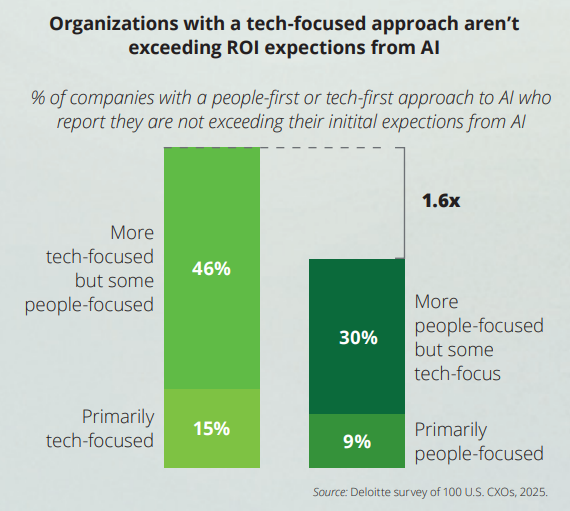
The issue is that the vast majority (93%) of organizations are focusing their AI investments onto data, tech and infrastructure, rather than people-related areas, like redesigning work, training and change management.
That’s according to Deloitte’s analysis of its customers’ expenditure on AI initiatives.
59% of 100 CXOs surveyed by Deloitte found that 59% are taking a tech-focused approach.
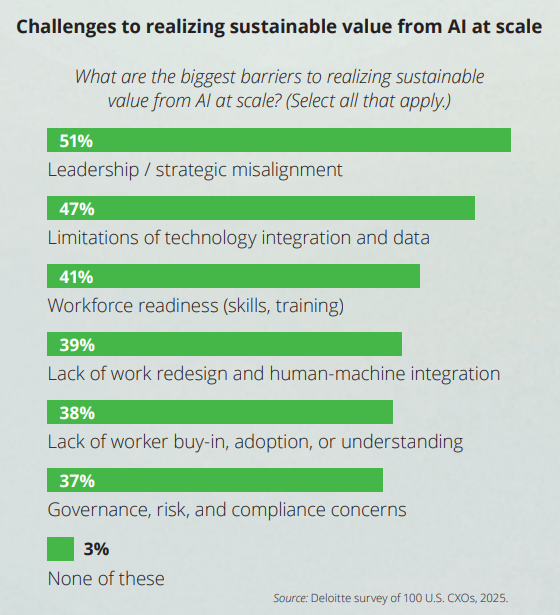
This is despite the fact that “when asked about the leading obstacles to scaling AI value, executives cited people factors above all else: leadership alignment, workforce readiness, lack of work redesign, and lack of AI adoption”, as Sue Cantrell, VP of Products, Workforce Strategies at Deloitte Consulting, tells UNLEASH.
For Deloitte, the reason why a tech-first approach to AI is not yielding the expected ROI is because “many organizations are still applying old playbooks to a fundamentally different kind of technology”, adds Cantrell.
Just a quarter (24%) of the CXOs surveyed believe that AI is very different from other tech implementations, however, “unlike prior technologies’ fixed, rule-based logic, AI predicts, learns, and evolves—it may not produce the same output every time even if the input remains the same”.
It’s time to break the habits of focusing solely on the tech side of AI – “companies that prioritize having humans and machines work together through redesigned roles, processes, and operating models are significantly more likely to realize measurable returns on AI compared to those taking a technology-first approach,” continues Cantrell.
Embracing work redesign means companies are twice as likely to exceed their ROI expectations when it comes to AI, according to Deloitte’s report.
At the end of the day, as Deloitte’s report stated: “When everyone has the same technology and uses it in the same way, AI can become a commodity—with even the fastest movers soon becoming one of many. To achieve enduring differentiation through AI in an increasingly democratized landscape, organizations must scale the human edge.”
The question that remains, is how to shift from a tech to people-first approach, and what role must HR teams play here?
“Think of it is this way: AI adoption without work redesign is like putting a jet engine on a horse-drawn carriage.
Work redesign doesn’t happen by accident; it must be intentional. “Work design must be approached as a discipline that requires skills and expertise, informed by data”, added the report.
The problem is that although HR has a central role in moving the needle on AI ROI, “only 12% of organizations say HR is leading AI-related work redesign, compared to 39% led by IT”.
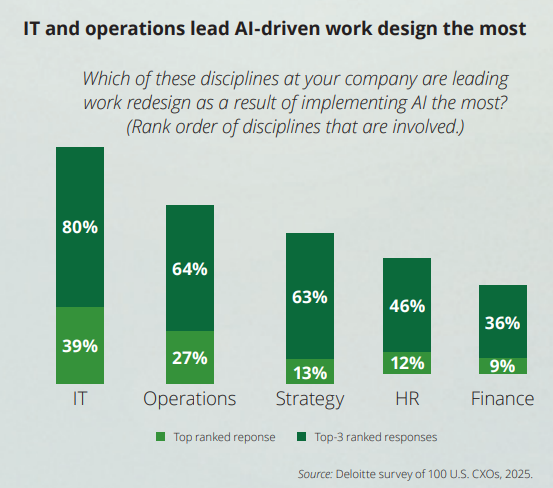
For Cantrell, this is “another clear outcome of the tech-first mindset”.
“Without HR’s input, organizations risk scaling AI without improving human outcomes or realizing a meaningful return on their tech investments,” she adds.
“This is also not just an HR issue. IT, finance, strategy, operations, and other functional areas all have critical roles to play in shaping how work gets done.
“Most importantly, work design must center around the people who know it best—the managers and workers who do the work and continuously experiment with improving it,” concludes Cantrell.